Saturday, February 28, 2009

What's up in the sky: Comet Lulin and Venus

The currently visible planets from Earth are always changing. In fact, the term "planet" comes from the Greek term, "wandering star", since they don't move like the rest of the sky.

That being said, I thought it would be informative to have a "What's up in the sky" section every couple of months to let people know what's visible if they just step outside and look up in the evening. Even from the middle of the most light-polluted cities, bright planets are still visible. I've already received a few questions pertinent to this.

Fitz asks:
I'm in Chicago, and I keep seeing what looks like a really bright star in the west. Is that Venus? What's the best way for a non-astronomer to find out these sorts of things (other than asking you!).
That's definitely Venus you're seeing. Other than the occasional airplane or bright satellite pass, Venus is the third brightest object in our sky after the Sun and the Moon. In fact, it's the object most frequently reported as a UFO.

Venus will be visible in the early evening sky in the West for the next month or so. As a planet on an orbit interior to Earth's orbit, it's currently "rounding the track" to pass in between us and the Sun, a phenomenon known as inferior conjunction. Because of this geometry, it's currently exhibiting a nice crescent phase and getting larger each night as it approaches us. At this point, with a good pair of binoculars and some keen vision, you should be able to make out that it's not merely a point of light, but a tiny crescent.

To answer the last part of your question, Sky & Telescope's This Week's Sky at a Glance provides a good overview of what's visible at any given time. Additionally, picking up some Planetarium software is also a good idea since it can be customized to your location and any date you want...there are some really good options out there. If you're a fan of open source software, I'd highly recommend Stellarium which can be downloaded from their subversion repository (side note: props to my subversion peeps).

Ben asks:
Comet Lulin is coming closest to earth tonight. Do I have a snowball's chance ... in space ... of seeing it?
Similarly, Tami asks:
I overheard a conversation yesterday that sounded like there was a comet in view the last few days, however it has been hazy here so there wasn't much view. Was there a comet visible recently? Which one? When? Where? Do you have any pics? How close is it to the earth? Is Armageddon inevitable?
Every couple of years we get a comet which is able to break the visible brightness barrier and can be seen with just the naked-eye. Comet Lulin is an example of this. Current estimates of its magnitude (brightness) place it at just above the naked-eye limit for a dark-sky site.

This comet is a bit of an interesting one. Its closest approach to the Sun was over a month ago, at a distance a good 20% greater than the Earth-Sun distance, but the geometry works out so that its closest approach to Earth was just four days ago at a distance just 40% of the Earth-Sun distance. (No worries, though, this is not even close to hitting us.)

Its orbit carries it *very* far from the Sun - over 3 light-years, in fact. At this distance, the Sun is not the only gravitational force acting on its orbit, but the gravity of other stars may start to be significant, so it's a little unclear if this comet will actually return to our solar system. Even if it does return, it won't be for another 50 million years. Whoa.

Now, that all said, it's not terribly spectacular with just the naked-eye...don't expect something similar to Comet Hale-Bopp back in 1997. You'll need a very dark sky to see it unaided, and it won't look like much more than a smudge. On good nights I can see the Milky Way from my yard, but I was unable to spot this comet with just the naked eye. With a decent pair of binoculars, though, it should stand out.

However, you'll have to hurry if you want to see this one. It's now moving away from Earth on its way out of the solar system, and won't be visible for long. It's currently rising over the Eastern horizon around sunset in the constellation Leo, though a finder chart is almost certainly necessary. You can find one here.

As for images, I'd recommend Spaceweather's Comet Lulin gallery...over 16 pages of images submitted by amateur astronomers.

Friday, February 27, 2009

Light: Particle & Wave

Karl asks:

So, photons. Radio waves. Electromagnetic radiation. Why do we only hear "photons" referred to for electromagnetic radiation that happens to fall within the visible spectrum for the human eye, plus some distance on either side of it, and then sometimes for anything above it (like gamma rays). But way down there in the radio wave regions, for some reason we're never talking about photons.

What's up with that? Is it just a matter of convention, or is there some kind of qualitative change as you go up the spectrum?
Good question. A pretty common confusion in physics is the dual nature of light: sometimes it acts like a wave, other times it acts like a particle. Specific to your question, though, you can absolutely talk about a "radio photon" or a "gamma ray wave", we simply don't encounter those terms in large part due to our methods of detection.

The only real qualitative change through the spectrum is energy per photon. Your average gamma ray photon will have an energy on the order of a trillion times more than your average radio photon, with a visible light photon somewhere in the middle - a million times less energy than gamma rays, and a million times more than radio waves.

Now, it's the deposition of this energy which allows us to detect it. In the case of modern visible light detectors (such as the CCD chip in your digital camera or at any observatory), a visible photon comes and hits the CCD, causing an electron to jump from being bound to a silicon atom to floating around in the sea of conduction electrons, which gets spilled out for reading at the end of an exposure. The point here is that the energy from a single photon gets filtered through to produce a noticeable, macroscopic effect in the electronics. Something similar applies to even shorter wavelength electromagnetic radiation like UV and X-rays - albeit in slightly different ways - that permits us to observe them on the individual photon level.

Radio, on the other hand, is a bit of a different beast. (I should also state that the radio astronomy world itself is somewhat disconnected from visible/infra-red astronomy.) A single radio photon isn't really enough to cause a noticeable difference in anything macroscopic. The wavelength of radio waves, however, *are* macroscopic. So, it's more reasonable to conceptualize radio energy as a sea of electromagnetic waves altering the electric field of your macroscopic antenna and producing a noticeable signal.

That's not to say radio photons don't exist. For example, atomic hydrogen which flips the spin state on its electron will cause a single radio photon (with a wavelength of 21 centimeters) to be emitted, and is a very important probe of gas in the galaxy.

So, I think the answer to your question is ultimately an observational predicament: which method of light conceptualization (particle or wave) causes the macroscopic change to your instrument.

Mars' Pole Star, and Blog of Note!

Well, it would seem that we've been listed as blogspot's blog of note! Yay, us!

Now, back to your regularly scheduled planetary astronomy questions. It's been a week since I've answered questions due to a massive computational fluid dynamics project I've been working on, so let's take these in order...Michael writes:
If you're standing on Mars, what star is closest to Mars' north pole?
I looked up the coordinates of Mars' north pole with JPL's Horizon ephemeris generator. This is the same web form that we planetary astronomers use when we get time on a big telescope and need to know where an object is, how high up in the sky it is, what phase it's in, etc. This is a huge resource for us, so a big thanks to the folks at JPL for providing for us.

It turns out the Earth-centric coordinates currently are:
RA: 317.67°
Dec: 52.88°

While there's no bright star right at that location, the closest one at about 7° away would be Deneb, an incredibly luminous white supergiant. Depending on which constellation scheme you go with, that star is either the head of the Northern Cross, or the tail of Cygnus the Swan.

Michael also asks:
Where's the Sun on the first day of Spring on Mars?
This is a good question. For the first day of Northern Spring on Earth, the Sun is located at a position known as the "First Point of Aries", a position that by definition is RA: 0°, Dec: 0°. The math gets a little tricky if we want to do this for Mars while staying in Earth-centric coordinates of RA and Dec (some icky spherical trigonometry is involved), so let's take advantage of JPL Horizons again.

It turns out to be on the edge of Sagittarius, almost perfectly lined up with the center of our galaxy.

Wednesday, February 18, 2009

Followup on escape velocity

Mike said:
Seven miles per second. That's the Earth's escape velocity, and the energy required to escape its gravity well...any slower and you'll fall back to Earth.
Karl wrote:
That's always confused me.

Sure, if you get moving to 7 m.p.s, then you'll escape without any further power. But couldn't you be going slower than that and still escape, as long as you continue to provide thrust?
Sure, that's possible, too. In general, though, orbital mechanics equations are generally done with instantaneous velocity changes (i.e. you suddenly go from zero to seven miles per second). This is for two reasons:

1) The orbital equations are just a whole lot simpler to work using instantaneous changes in velocity - it's only algebra. With acceleration over a prolonged period, though, it suddenly becomes a calculus equation.

2) Until very recently, velocity changes to get into and subsequently alter orbits of spacecraft were only done with chemical propellants. Since these are short-lived accelerations, they can be treated as instantaneous to first-order. This is particularly the case for large booster rockets, where once you start the rocket, the whole thing keeps going until it's finished.

Now, reason #2 has recently changed with the creation of spacecraft with ion engines. These engines work on a very different principle...they continuously accelerate individual atoms past an electrified grid, which means very small thrust but over very long periods of time. For more info on this, check out NASA's FAQ on Ion propulsion currently featured on such spacecraft as the Dawn mission to asteroid Vesta.

What you're ultimately trying to do with escape velocity is overcome the Earth's gravity well by raising your potential energy to that of an object at an infinitely far distance. Even though it sounds counter-intuitive, it turns out that this is actually a finite quantity of energy because as distance increases to very large values, the force of gravity becomes infinitesimally small.

As long as you can get your kinetic energy moving away from the Earth equal to this potential energy at infinity, you can escape. Seven miles per second is the oft-quoted figure because that velocity provides a body with enough kinetic energy to be equal to the difference in potential energy between Earth's surface and an object at infinity.

So, to be clear, you ultimately don't need to be going seven miles a second to begin with. You can alter your velocity on the way up however you please...but in the end, you'll have to end up spending at least as much energy as you would've going 7 miles per second initially.

Happy Anniversary, Pluto!

Jennifer wrote:
I tried the 5 year old explanation on my son today, with a few extra details thrown in to set the scene. I swear I saw stars sparkling in his eyes when I finished. Worked like a charm :).
Nice, glad it worked!

One final postscript I forgot to mention on all of this to make it particularly fitting: today is the 79th anniversary of Pluto's discovery.

In honor of the anniversary, I just came from a department event announcing the newly created position of the Clyde Tombaugh endowed chair. Patsy Tombaugh, Clyde's widow, spoke at the event to a packed room. She quoted Clyde in what I thought was a particularly nice sentiment: "How can people not be interested in astronomy? Don't they want to know where they are?"

Mike.

Mars, Escaping Earth, and Why Pluto isn't a Planet

Jennifer wrote:
Dear Planetary Astronomer Mike,

I have a 5 year old son who's heart is set on traveling to mars (and a three year old daughter who would like to rocket ship to mars). He often has questions about the planets, the sun, and earth.
Well, we'll see what happens to Bush's lofty goal of getting humans to Mars. It's not such a terrible idea, just completely underfunded by the last administration.

Most planetary astronomers I know are waiting with baited breath to see who Obama appoints as NASA administrator, as it will deeply affect future science policy. From reading the tea leaves, the guess is that there will a lot of new funding for Earth climate satellites and research...which also isn't such a terrible idea.

Jennifer continued:
My daughter (who is determined to be in this email because she must be just like her brother) wants to know how fast a rocket ship has to move to get her to the moon.
Seven miles per second. That's the Earth's escape velocity, and the energy required to escape its gravity well...any slower and you'll fall back to Earth.

Jennifer concluded with:
For the last week my son's been asking me why Pluto is not a planet and what it is/how it formed.
Okay, this is actually a pretty popular question, and I've given a couple talks about it. It's also a question that that hits home - our astronomy department was founded by Clyde Tombaugh, discoverer of Pluto.

So, imagine the following scenario:
  1. Astronomers have mapped out our solar system, and after some analysis are expecting to find a planet where one has not yet been found.

  2. After careful searching and some serendipity, an observer finds a tiny light moving among the heavens. Plotting its course, it turns out to be an object exactly where a planet was expected...though it's somewhat smaller than expected.

  3. Astronomers rejoice! A new planet has been found! We're so smart!

  4. Time passes...when suddenly a new object is discovered at almost the exact same distance from the Sun...curious. Another planet? In the same orbit?

  5. Another object at the same distance is discovered.

  6. Another object at the same distance is discovered.

  7. Another object at the same distance is discovered.

  8. etc.

  9. After compiling a vast array of objects all orbiting in roughly the same orbit, maybe these aren't planets after all.
The above scenario perfectly outlines what actually happened...with Ceres, the first asteroid ever discovered. (Ha! Tricked you!)

By the late 1700's, astronomers were disturbed by the conspicuous gap between Mars at 1.6 AU and Jupiter at 5.2 AU (1 astronomical unit = 1 AU = the distance between Earth and the Sun). Titius and Bode drew up an entirely empirical equation to calculate the distance of planets from the Sun which worked out quite nicely. There was a missing term in their equations, though...precisely in this gap, around 2.5 AU, suggesting there should be a planet there. Quoting Titius from 1768:
"After Mars there follows a space of 4+24=28 parts, in which no planet has yet been seen. Can one believe that the Founder of the universe had left this space empty? Certainly not."
The stage was further set by Herschel, who had discovered the planet Uranus in 1781. After his discovery, astronomers had warmed to the idea of finding new planets telescopically...it was new, it was happening, it was the in thing to do. Moreover, Uranus fits perfectly as the next term of the Titius-Bode equation. A coordinated observing campaign was begun to search for the missing planet.

Along comes Giuseppe Piazzi, an Italian monk and hobby astronomer. After dutifully scanning the heavens, on the first night of the new millennium, January 1st, 1801, he observes a tiny "star" where none had been before. He follows it night-to-night and observes it moving...at first it was thought to be a comet, but after careful calculation astronomers realize this is exactly what they've been looking for. It is dubbed Planet Ceres. All is well, and astronomers pat themselves on the back for being so very clever.

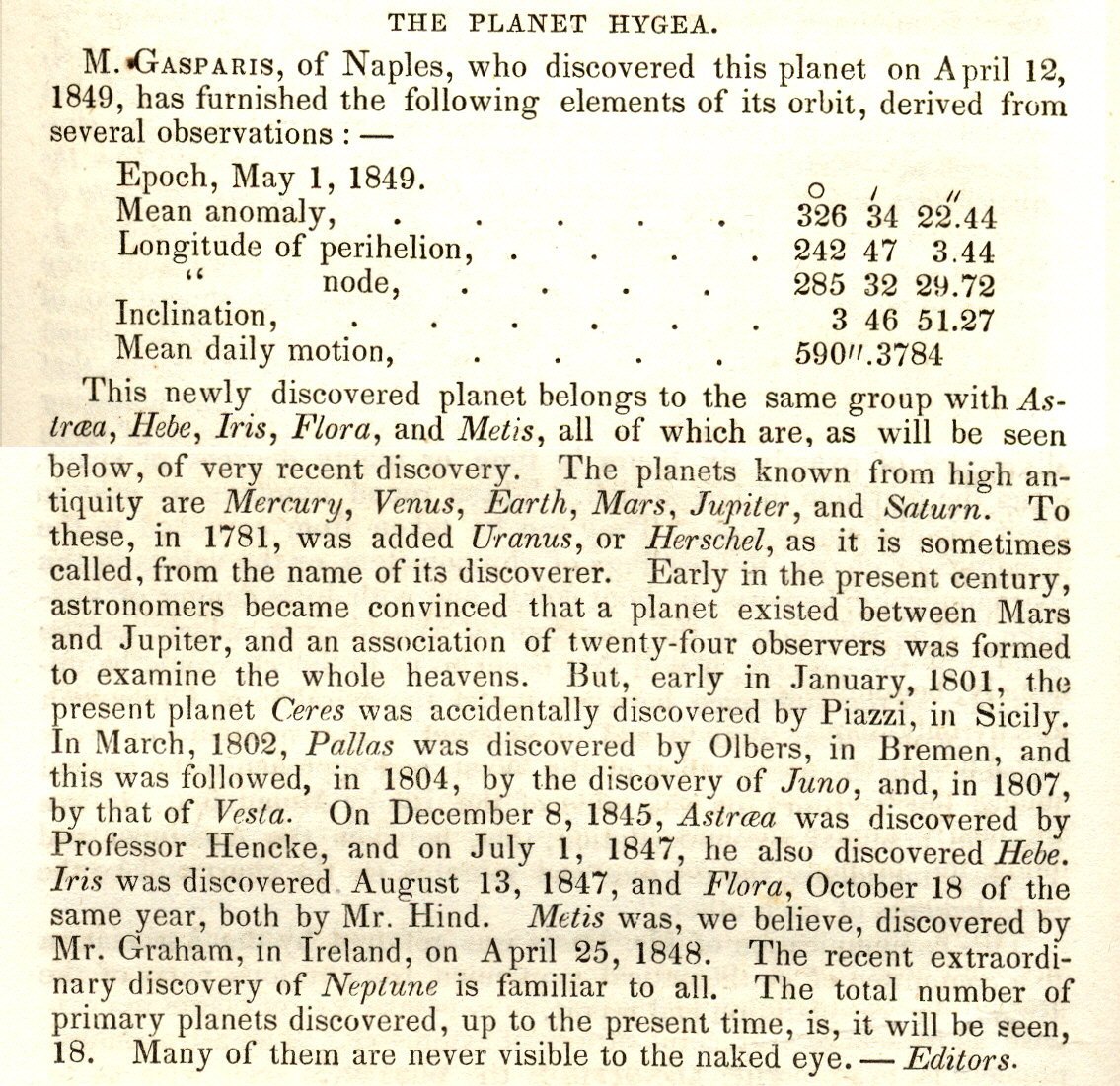
Then in 1802, Heinrich Olbers finds another object at roughly the same distance as Ceres...the, uh, Planet Pallas! In 1804, Planet Juno is discovered...in 1807, Planet Vesta is is discovered...something is amiss. By 1850, there were 13 of these new planets...Here's a page from the 1850 Annual of Scientific Discovery which documents all 18 planets at the time.

It wasn't until 1852 that these objects were reclassified as "minor planets"...which is a good thing, since we know now of roughly 300,000 minor planets that are hardly on the same footing as the classic 8. Science-wise, it makes a lot more sense to group these objects into a family of astronomical bodies, the asteroid belt. Still, for 51 years Ceres enjoyed full planet status.

Now, also in this time period (1846) Neptune was discovered at 30 AU. Small gravitational perturbations in the motion of Uranus caused scientists to theorize the existence of a large planet further out. Le Verrier and Adams both independently calculated where such a planet should be...but Le Verrier was given telescope time first, and Neptune was found very close to its predicted position. This was a huge triumph of predictive science (and one of the few cases in history where the scientific method was more important to discovery than serendipity...but that's another topic).

Hoping to follow on this success, Percival Lowell hoped to do something similar some 80 years later. Having then detected subtle perturbations in the orbit of Neptune, he funded the search for "planet X", a large planet even further out. Initial observations were less than successful...planet X's position had to be recalculated 3 times after initial searches turned up nothing. But, in 1930, Clyde Tombaugh observing at Lowell Observatory discovered a tiny light moving night-to-night. 40 AU out...this was it! Planet Pluto! Once again, astronomers congratulated themselves on their sheer brilliance, and their fancy scientific method.

At first, Pluto was calculated to have a mass 7 times larger than the Earth. Over time, though, this was amended, and it turned out the new planet was a bit smaller. A lot smaller, in fact. In 1978, Pluto was found to have a moon, which allowed a precise determination of its mass...Pluto was found to be about 5 times less massive than our Moon. But, hey, it's a planet, who are we to argue?

By 1989, the scientific method took another blow...the Voyager spacecraft passed by Neptune allowing for a precise orbit determination, and discovered that those initial gravitational perturbations which Lowell measured simply didn't exist at all. They were observational errors. Planet X was found, again, by sheer serendipity...the third predicted position based on flawed Neptune data just happened to line up with the position of an actual object.

Still a planet, though, right? Things get trickier in 1992...David Jewitt discovers 1992 QB1 orbiting at almost the same distance as Pluto from the Sun. It's only one-fifth the radius of Pluto, though, so that's hardly planet-y at all.

Time passes. More objects are discovered around this distance from the Sun...about 1,000 more, though they're all smaller than Pluto. This situation is starting to sound really familiar, when suddenly in 2006 Mike Brown discovers 2003 UB 313 (now known as Eris). Radius determinations find that Eris is actually larger than Pluto...uh oh.

Crisis ensues. If Pluto is a planet, and Eris is bigger, then Eris is a planet, too, right? Or was Pluto never really a planet, after all? The International Astronomical Union, the body responsible for all solar system object naming, steps in. It's put to a vote, and the criteria for a planet are established:
  • It has to orbit a star. (Pluto: check.)
  • It has to have enough mass to be round. (Pluto: check.)
Initially this was it...it would have included Pluto as a planet, but 52 other solar system objects as well. That's a few too many to be useful, so, one more criterion was added:
  • It must have cleared its orbit of all other bodies. (Pluto: crap.)
That final criterion is the problem for Pluto. It's a simple calculation: just compare the mass of a planet to the mass of all the stuff in the planet's orbit. Earth is responsible for 99.999% of all the mass of in its orbit. Pluto, on the other hand, is responsible for just 7% of the mass in its orbit.

Objects meeting criteria 1 & 2 but not criterion 3 are now "dwarf planets"...officially this include Pluto, Eris, Haumea, Makemake, and Ceres so far. Pluto enjoyed full planetary status for 76 years...not terribly different than Ceres, really.

It also makes sense...just as all the objects between Mars and Jupiter are collectively known as the asteroid belt and have a common origin, so all the object around 40 AU are collectively known as the "Kuiper Belt" and have a common origin. This bring us to the final part of your question: what is it, and how did it form.

Until recently, there were two competing theories for solar system formation: gas instability and core accretion. Both start with the extremely early solar system, where a swirling disc of gas and dust surrounded the proto-star that would become our Sun. Gas instability says that little over-dense nuggets of gas and dust in the disc gravitationally collapse to make planets. Core accretion states that first dust particles stick together to start forming larger and larger planetesimals, whose gravity then grows to the point that they can start pulling in the surrounding gas. For several reasons I won't get into (unless someone asks), gas instability has fallen out of favor with the astronomical community, though the debate isn't quite over yet.

Based on core accretion, particularly in the outer solar system, you start with these planetary "seeds" that suck in gas and make gas giant planets...at some point, though, you run out of gas to accrete. Add to that the slow orbital speed and huge distances between objects out at 40 AU, and you'll find that seeds at Pluto's distance never merged together enough to get in on the big gas feast.

Anyway, we're pretty sure this is what happened to Pluto...put in terms for a 5-year-old, its big brothers Jupiter, Saturn, Uranus, and Neptune ate up all the gas before Pluto got any, so it's been left as just a lonely little planet seed. I think there's probably a moral in there somewhere for him about sharing with his sister, too.

Mike.

Tuesday, February 17, 2009

Another Followup: Does Glass Flow as Fast as the Mantle?


Mike said:
...if water has a viscosity of 1 and honey has a viscosity of a few thousand, rheids in the mantle are on the order of a few billion.
Roland asked:
How does glass compare?
Oh boy, the whole "glass is a liquid" thing. Yes, I was taught this in a grammar school science class, and it is wrong, wrong, wrong! Sorry, don't mean to get excited here, but oft-repeated scientific fallacies are a big pet peeve of mine..."glass is a liquid", "there's no such thing as centrifugal force", "the moon is bigger on the horizon", "toilets flush backwards in the southern hemisphere", etc. They all drive me nuts. For a while I even flirted with the idea of registering scientificfallacies.com as a domain name for a site specifically designed to debunk these.

Anyway, yes, glass is an amorphous solid...I think the Corning site (a manufacturer of glass) has an excellent write-up about this.

I particularly like the bit about lead flowing 1 billion times faster than glass. For perspective, the whole justifying argument of "glass is thicker at the bottom than the top of old church windows" would mean that astronomical telescopes with large glass mirrors would go out of focus in a matter of weeks.

Now, how does glass flow compare to rheids in the mantle? Well, it's a little hard to do so, particularly since the mantle covers such a wide range of temperatures. At depth, the magma viscosity is lower (i.e. it flows more easily) than near the crust, simply because the temperature increases as you go down.

That said, though, the upper mantle is usually pegged with a viscosity in the neighborhood of 10^20 poise, shockingly almost the same as that given for glass. The reason why the rheids in the mantle flow better than glass in the church window is simply a matter of pressure. In the church window, the only force compelling the glass to flow is gravity. This is extremely weak in comparison to the mantle being forced by the pressure of gigatons of material above it.

Put in another way, remember that viscosity is just a measure of resistance to flow, not flow itself. A pool of honey will move much more slowly if you poke it with your finger than if you hit it with a hammer, even though the viscosity doesn't change. Similarly, mantle rheids and glass both have about the same resistance to flow...just that in the mantle case the applied force is much, much greater such that it flows on the order of centimeters per year.

Mike.